
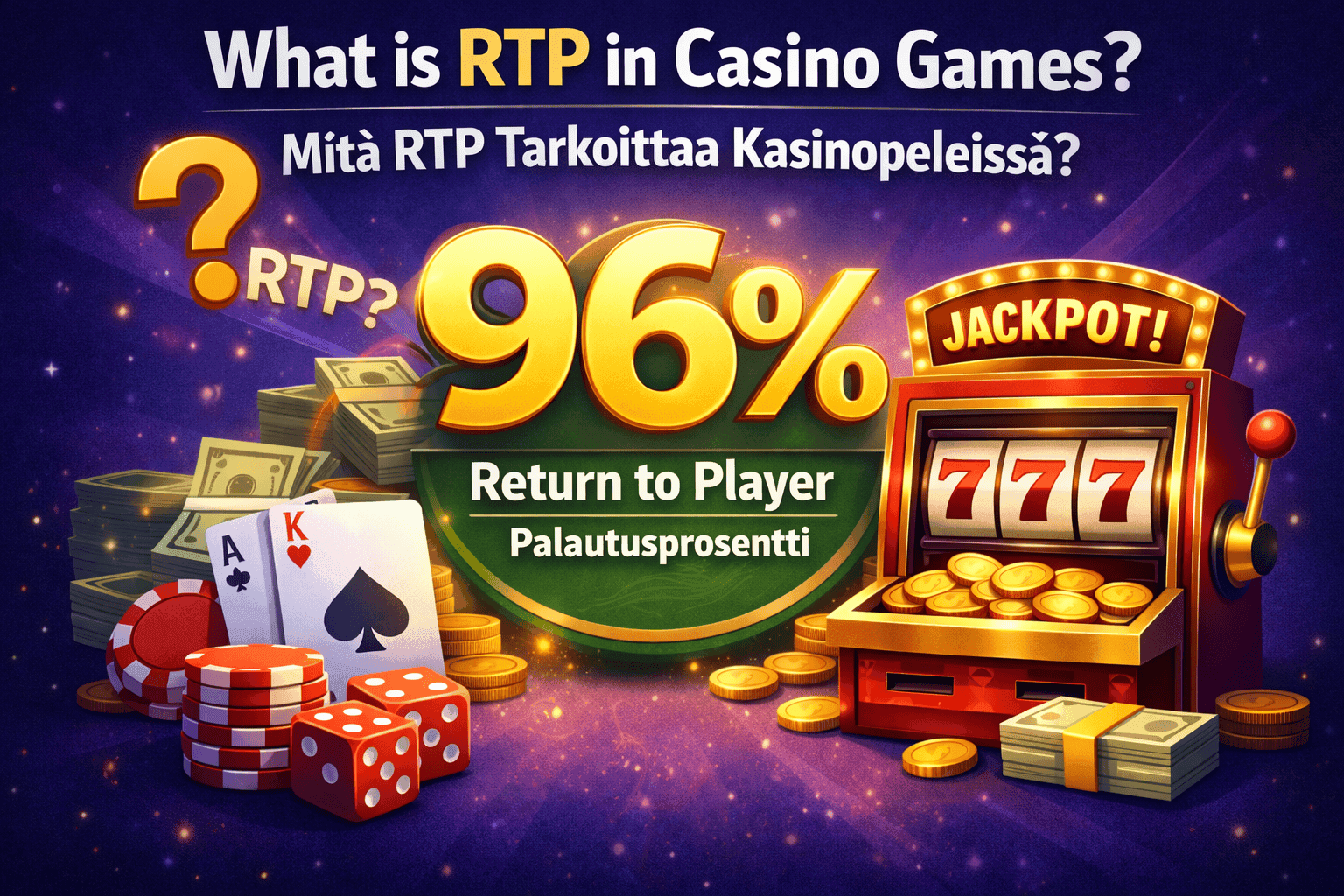
What Does RTP Mean in Casino Games?
Find out what RTP means in casino games and what the return-to-player percentage tells you before playing.
Find out what RTP means in casino games and what the return-to-player percentage tells you before playing.
RTP stands for Return to Player. It refers to a game’s theoretical payout percentage and shows how much of the total money wagered is expected to be paid back to players over the long run.
For example:
RTP is most commonly discussed in relation to slot games, but the same principle applies to many other casino products.
RTP reflects a long-term statistical average, not the outcome of any individual spin or session.
That means RTP:
This is an important distinction, as many players mistakenly assume RTP represents their short-term winning chances.
Think of RTP as the game’s mathematical expected return.
If a slot has:
Then over millions of spins:
This is often referred to as the house edge.
House Edge = 100% − RTP
Examples:
| RTP | House Edge |
|---|---|
| 96% | 4% |
| 94% | 6% |
| 92% | 8% |
While standards vary by provider and game type, many players use the following general benchmark:
| RTP Range | Interpretation |
|---|---|
| Below 94% | Low RTP |
| 95–96% | Average |
| 96%+ | Good RTP |
| 97%+ | Excellent RTP |
In general:
The higher the RTP, the lower the expected long-term cost of playing.
However:
A higher RTP does not make a game easier to win in the short term.
RTP is useful because it helps players compare games on an objective scale.
Two slot games may look similar visually, but:
Over time, that difference has a major impact on expected losses.
For this reason, RTP is one of the most important statistics to consider before playing.
A common misunderstanding is believing RTP applies evenly across every session.
It does not.
Because casino games use random number generation (RNG):
RTP only becomes meaningful over very large sample sizes.
RTP and volatility are often confused, but they measure different things.
Two slots can both have 96% RTP, yet feel completely different:
That’s because RTP says nothing about how payouts are distributed.
Yes.
Many providers offer multiple RTP configurations of the same slot.
For example:
This is why checking RTP inside the actual game is important.
RTP is usually shown inside the game itself, typically in:
Always check the RTP of the specific version you are playing.
RTP is one of the best tools players have for understanding a casino game’s long-term value.
To summarise:
Ultimately:
RTP is useful for comparing games — but it is only one part of the overall picture.